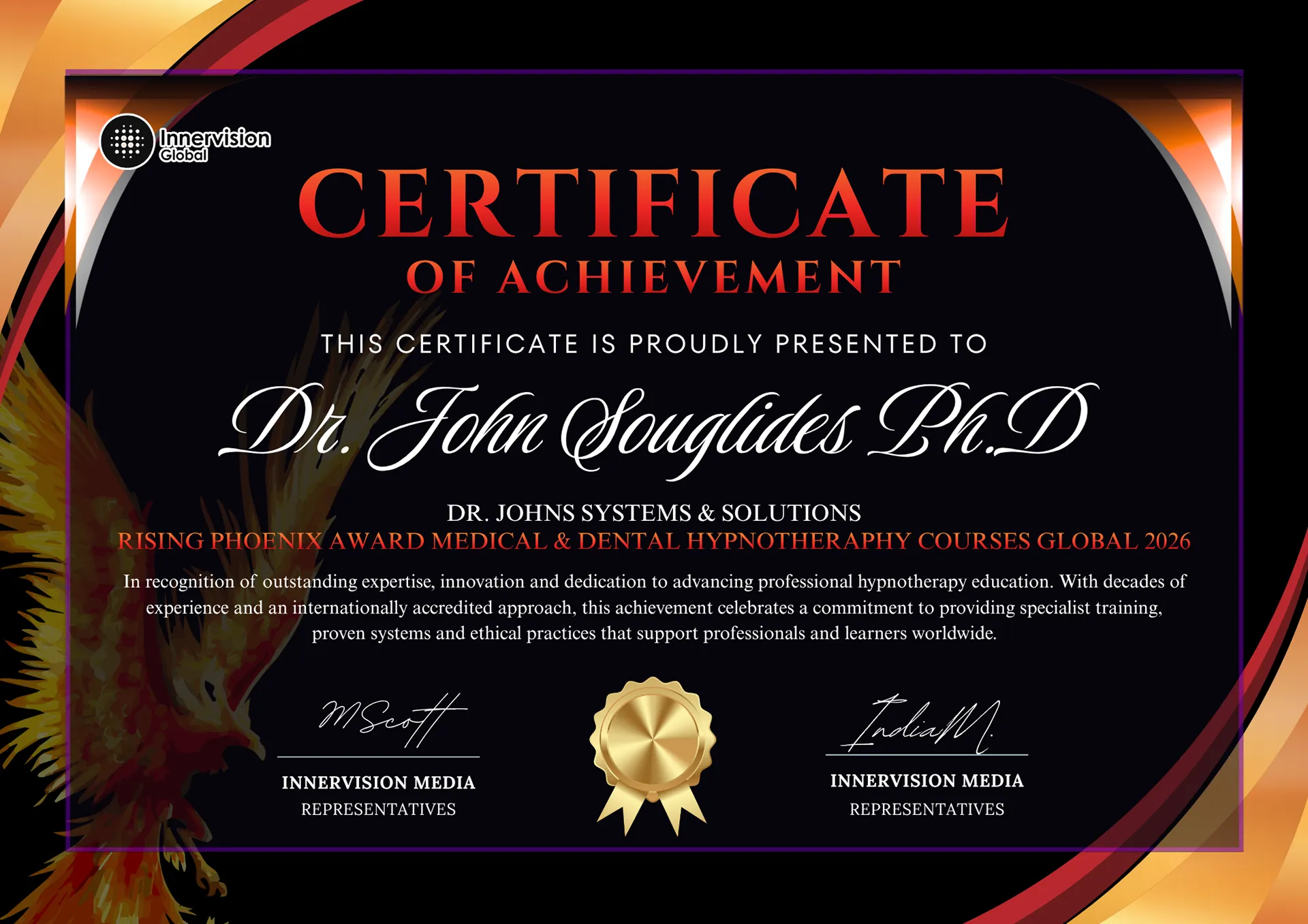
Dr. John Souglides is proud to have been named winner of the Rising Phoenix Award for Medical & Dental Hypnotherapy 2026.
View the press release here.
Here’s his Q & A with Innervision Global:
Q1. Can you tell us about your journey and what inspired you to pursue this path?
My journey has never been simply about building a career; it has been about understanding the human being in their entirety, mind, body, emotions, consciousness, spirit, and the extraordinary potential that exists within each of us.
I began assisting people on their personal journeys in 1989, and over the decades my path evolved through hypnosis, non-medical hypnotherapy, analytical hypnotherapy, holistic life coaching, transpersonal counselling, NLP, mentoring, metaphysics, consciousness development, and holistic wellness. I have continued to study, teach, and develop my understanding because I have always believed that genuine mastery is not a destination, it is a lifelong commitment to learning and service.
What inspired me most was witnessing what happens when a person who has felt powerless for years suddenly begins to recognise their own inner power.
I have seen people arrive carrying fear, grief, anger, limiting beliefs, destructive patterns, anxiety, self-doubt, or a sense that life has somehow passed them by. Then, through the right guidance, something begins to shift. They start seeing themselves differently. They realise that the story they have been living is not necessarily the story they have to continue living.
That is where my passion comes from.
I do not see my role as giving people a life. I see my role as helping them rediscover the wisdom, resources, resilience, and potential that already exist within them.
For me, hypnotherapy, coaching and mentoring are not merely techniques. They are pathways into deeper self-awareness and self-empowerment. My purpose has always been to help people move from surviving their circumstances to consciously participating in the creation of their lives.
Q2. What were some of the biggest challenges you faced along the way, and how did you overcome them?
One of the greatest challenges has been understanding that transformation does not always happen according to our preferred timetable.
There have been moments when progress was difficult, when circumstances were demanding, and when the path ahead was not immediately clear. Like anyone who chooses a life of service, I have experienced setbacks, uncertainty, disappointment, and periods that required enormous resilience.
What I learned is that adversity is not necessarily the opposite of our journey, it can become part of our education.
I learned to stop asking, “Why is this happening to me?” and to begin asking, “What is this here to teach me?”
That shift in perspective is profoundly powerful.
I also learned that resilience is not about pretending that difficulties do not exist. True resilience is the ability to meet reality honestly without allowing reality to define the limits of your potential.
My professional development has therefore always been accompanied by personal development. I have continued studying, refining my skills, learning from mentors and teachers, and challenging my own assumptions.
Perhaps the greatest lesson has been this: you cannot authentically guide others toward transformation while refusing to transform yourself.
Every obstacle has therefore become an invitation to deepen my understanding, strengthen my character, and become more useful to the people who place their trust in me.
Q3. Was there a defining moment in your career or personal journey that changed everything for you?
There have been many significant moments, but the defining realisation has been that the most profound transformation does not come from changing the world around us first, it begins with changing our relationship with ourselves.
Over the years, working with people from enormously different backgrounds taught me that beneath the surface differences, human beings share many of the same fundamental struggles: fear, insecurity, grief, shame, self-doubt, unresolved experiences, limiting beliefs, and the longing to be understood.
That understanding changed the way I practise. I became increasingly interested not simply in the presenting problem, but in the person behind the problem.
What is the belief beneath the behaviour?
What experience created the emotional pattern?
What has this person been taught to believe about themselves?
And perhaps most importantly: Who might this person become if they were no longer governed by the limitations they had unconsciously accepted?
That became a central principle of my work.
It is why I approach each individual as unique rather than attempting to place people into predetermined boxes. My responsibility is to listen deeply, understand the individual, and then use the appropriate tools and knowledge to help them move toward greater awareness, empowerment, and meaningful change.
Q4. What does receiving the Rising of Phoenix Award mean to you personally and professionally?
The Phoenix is an extraordinarily meaningful symbol because it represents something much deeper than simply rising after adversity.
It represents transformation.
The Phoenix does not return from the ashes as the same being that entered the fire. It emerges renewed.
That symbolism resonates deeply with my life’s work.
I have spent decades witnessing people go through their own metaphorical fires, loss, fear, trauma, disappointment, addiction, anxiety, relationship difficulties, self-doubt, destructive patterns, and profound life transitions, and then watching them discover that their circumstances do not have to become the final definition of who they are.
Receiving the Rising of Phoenix Award is therefore deeply humbling.
Professionally, I see it as recognition not only of my work, but of the importance of the message behind the work: human beings possess an extraordinary capacity for renewal.
Personally, I receive it with gratitude.
An award is never solely about the individual receiving it. Behind every meaningful professional journey are the people who trusted you, the teachers who guided you, the mentors who challenged you, the colleagues who supported you, and the countless individuals whose stories have taught you something.
So I accept this honour with humility and with a renewed sense of responsibility.
If my journey can remind even one person that their present circumstances are not necessarily their final destination, then the recognition carries a meaning far beyond the award itself.
Q5. What motivates you to keep striving for excellence despite setbacks or obstacles?
My motivation comes from purpose rather than perfection.
Perfection is an impossible destination. Excellence, however, is a commitment to continually becoming better, wiser, more knowledgeable, and more useful to others.
After more than three decades in this field, I still consider myself a student.
That may sound paradoxical, but I believe it is essential. The moment a practitioner believes they know everything is the moment their growth begins to stagnate.
Every person I work with teaches me something. Every challenge reveals something. Every new area of study opens another door.
What motivates me most is knowing that the work can have a meaningful ripple effect.
When one person changes, their relationships can change. Their family can change. Their children can experience them differently. Their professional life can change. Their confidence can change. Their understanding of themselves can change.
Transformation rarely stops with one individual.
That is why I continue to pursue excellence, not to accumulate titles, but to deepen my ability to serve.
Q6. Who or what has been your biggest source of inspiration throughout your journey?
My greatest inspiration has come from several sources: my teachers and mentors, the wisdom gained through experience, the people I have had the privilege of helping, and the extraordinary mystery of human consciousness itself.
I have always been fascinated by the question of what human beings are truly capable of when they become conscious of their own inner resources.
My mentors have reminded me that knowledge without wisdom is incomplete, and wisdom without compassion can become detached from the very people it is intended to serve.
My clients and students have also been among my greatest teachers.
Every person carries a story that deserves to be heard.
Some people have demonstrated extraordinary courage simply by asking for help. Others have taught me about resilience by rebuilding themselves after experiences that could easily have broken them.
And then there is consciousness itself, the vast, fascinating landscape of the human mind.
That continues to inspire me because the more we learn, the more we realise how much remains to be understood.
Q7. What achievements are you most proud of so far?
I am proud of my longevity and dedication to this field, having begun assisting people in 1989 and continuing to evolve professionally over more than three decades. I am proud of becoming an internationally accredited practitioner, educator, mentor, and specialist across several complementary disciplines.
I am also proud of my academic and professional development, including my doctorates in Transpersonal Counselling, Holistic Life Coaching, Parapsychology, and Martial Art Science, as well as my continued work in hypnotherapy, hypnosis, coaching, mentoring, consciousness development, and holistic wellness.
I am particularly proud of developing educational programmes that allow knowledge to be passed forward.
Teaching is important to me because knowledge should not end with the person who acquires it.
Through my specialist training and educational work, including The Art of Hypnosis Training Course, I have had the privilege of helping others develop their understanding and skills so that they too can serve and empower others.
But if I am completely honest, my greatest achievements cannot be measured by certificates, titles, qualifications, awards, or professional milestones.
My greatest achievement is the person who tells me, “I see myself differently now.”
That moment is priceless.
Q8. How has your journey shaped the way you approach your work or mission today?
My journey has taught me that transformation must be individualised.
There is no universal formula for being human.
Two people can experience the same event and carry completely different meanings from it. Therefore, my approach is not simply to treat a symptom or impose a methodology. It is to understand the individual and identify what is truly standing between them and the life they want to create.
Today, my mission is centred on self-awareness, self-empowerment, personal responsibility, and transformation.
I want people to understand that seeking guidance is not a sign of weakness. In many cases, it is an act of courage.
My work combines the disciplines and knowledge I have developed over decades, including hypnotherapy, hypnosis, holistic coaching, NLP, mentoring, counselling, and broader approaches to consciousness and personal development. (Dr. Souglides)
But beneath all of those methodologies is one fundamental principle:
The goal is not to create dependence upon the practitioner. The goal is to help the individual become more conscious of their own capacity.
I want people to leave my work with greater clarity, greater self-awareness, greater responsibility for their choices, and a stronger connection to their own inner wisdom.
Q9. What advice would you give to others who are currently facing challenges but aspire to rise above them?
First, do not confuse where you are with who you are.
A difficult chapter is not the whole book.
There are moments in life when everything appears to be falling apart, but sometimes what is falling apart is simply what can no longer accompany us into the next chapter.
Do not be ashamed of asking for help. Strength is not the absence of vulnerability. Strength is having the courage to acknowledge where you are and the willingness to take the next step.
I would also encourage people to question the beliefs they have about themselves.
Ask yourself:
Is this really my truth, or is it a belief I inherited, learned, accepted, or repeated until it felt like truth?
Our beliefs influence our perceptions, our perceptions influence our emotions, and our emotions influence our behaviours and choices. When we begin examining those internal patterns, we create the possibility of responding differently.
And finally, be patient with yourself.
Transformation is rarely one dramatic moment. More often, it is a series of small decisions made consistently.
You do not have to rebuild your entire life today.
You only have to take the next meaningful step.
And remember this:
The Phoenix does not rise because the fire was easy. It rises because the fire did not have the final word.
Q10. What are your goals for the future, and how do you plan to continue making an impact?
My vision for the future is to continue expanding the reach of transformational education, hypnotherapy, hypnosis, mentoring, holistic life coaching, and consciousness development while maintaining the depth, integrity, and personal attention that have always been central to my work.
I want to continue educating and mentoring practitioners, developing specialist programmes, delivering transformational workshops and conferences, and making high-quality guidance accessible to people internationally. My work already extends through online services, education, specialist training, corporate wellness, retreats, and professional speaking.
But ultimately, my goal is larger than any particular programme or professional title.
I want to contribute to a culture in which people become more conscious of themselves, more responsible for their choices, more compassionate toward others, and more willing to explore their own potential.
I believe the future of personal development lies not in simply teaching people how to achieve more, but in helping them understand why they want what they want, who they are becoming in the process, and whether their success is aligned with their deepest values.
I also want to continue passing knowledge forward.
If I can educate another practitioner who goes on to help hundreds of people, and those people go on to positively influence their families and communities, then the impact multiplies far beyond anything I could accomplish alone.
That is the legacy I am interested in.
Not simply being remembered for what I achieved, but for what I helped awaken in others.
And perhaps that is the true meaning of rising.
We do not rise merely to stand above where we once were. We rise so that we can see further, understand more deeply, and extend a hand to those who are still finding their way through the darkness.
- That is the work.
- That is the responsibility.
- And for me, that is the privilege.